
Introduction
The 2026 midterm elections were a critical inflection point for our pro-democracy movement, and Asian American organizing continues to be a deciding force between the multi-racial future we are fighting for and a backslide into fascism. At our recent post-election briefing for funders and donors, GAR Executive Director Roksana shared about what grassroots organizing made possible this election cycle, what GAR has built, and what comes next for GAR.
With the results of the election, there is a window of opportunity right now to organize, sustain, and ground working-class communities for the long haul.
What difference did Asian Americans make for our democracy’s future in the Midterm elections?
Some of the biggest shifts in grassroots organizing and electoral wins happened in states in the Midwest and South! As the cost of living rises in coastal cities, more and more working-class Asians have been moving to the Midwest and South in search of a more affordable life. These are places that historically have very little organizing infrastructure for Asian American communities, with the exception of GAR’s members based in these states.
States like Michigan, Georgia, North Carolina, and Texas have been long dominated by Republican power in state and local governments. Grassroots organizations have been doing targeted outreach to and developing the leadership of working-class Asian people, which has changed the trajectory of politics in these states. Recently, Roksana was in Michigan to train SEIU’s AAPI executive board members on the Wedges Framework. Those SEIU members then took learnings from those trainings and applied them directly to conversations they had while canvassing voters in Michigan.
Elections are a moment where we test how we have been organizing throughout the year. What happens in the weeks before an election shows us how deep our relationships run and where gaps remain. Whether a community’s concerns become a source of division or foundation for lasting power depends on who is organizing those conversations, in what languages, and to what frequency. Read more.
What is GAR’s Wedges Framework?
In 2024, GAR members met in Chicago to deepen our collective understanding about the multiple pro-authoritarian forces that our communities are dealing with and the various strategies these forces are using to attack our communities. At the time, organizers were seeing an extreme resurgence of pro-authoritarian forces, both nationally and locally amongst Asian communities with patterns of the Chinese Right, Hindutva, and other forces gaining political power and local influence.
Following that, a committee of GAR members, including AAAN, ACE, APEN, DRUM, HANA Center, Lavender Phoenix, and SEAC Village, refined how we can "wedge" pro-authoritarian forces against each other and sway our communities back towards us. With the support of GAR staff, GAR members created the Wedges Framework and Organizer Workbook as a tool to guide organizers on identifying wedge issues to inoculate pro-authoritarian narratives and organizing.
The results of the midterm elections confirmed what Asian organizers in GAR already knew: Working-class Asian communities are actively contested and key to winning elections. Organizers must build influence, connection, and legitimacy amongst these communities.
Wedge issues were key in the Midterm elections.
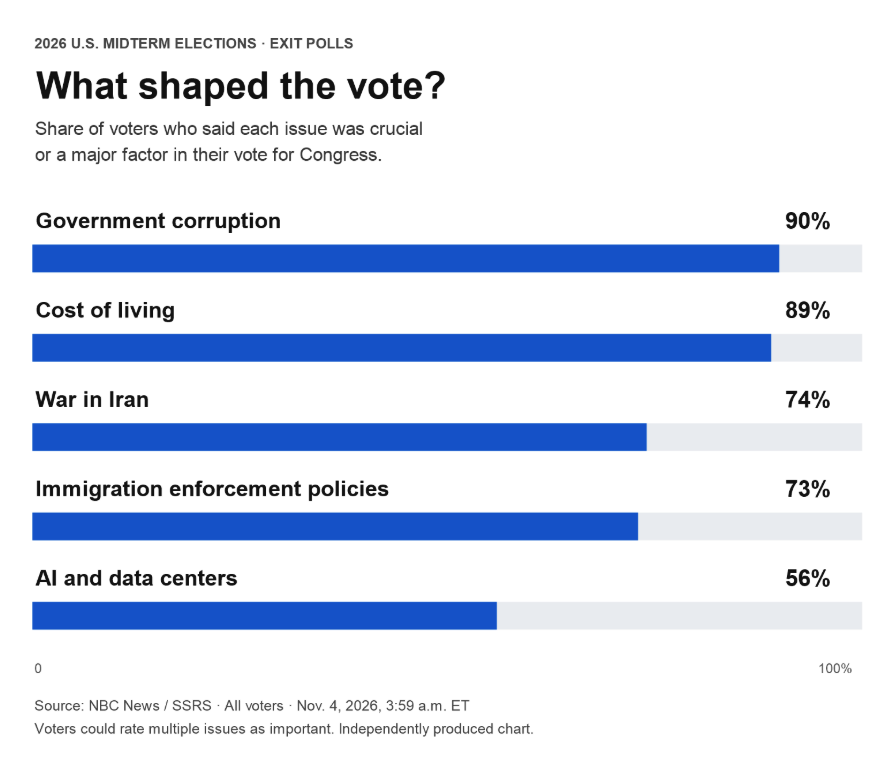
Exit poll results from the 2026 U.S. midterms showing the share of voters who rated each issue as decisive or important.
Voters named the following issues in the election as swaying how they chose to vote in the Midterm elections: government corruption, cost of living, war in Iran, immigration enforcement policies, and AI and data centers. How the Trump administration has moved the country in these issues and how voters were talked to about these issues led to the results of the midterm elections.
In 2024, when GAR first created the Wedges Framework, GAR member organizations selected four key wedge issues to organize working-class pan-Asian communities around, including public benefits, universal healthcare, attacks on immigrants, and the affordability crisis. These same four issues are reflected directly in what voters said issues moved them in the Midterm elections.
Divesting in Organizing Sustains Compound Crises
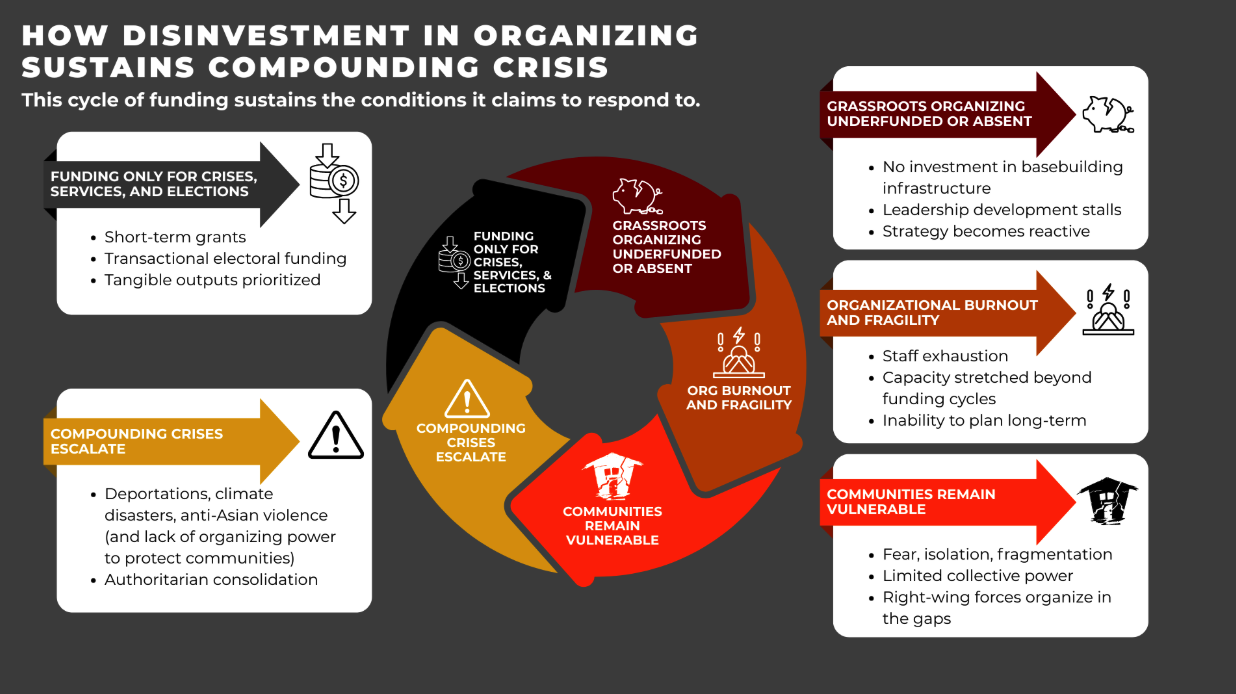
Many Asian American organizations, both nationally, and locally, are operating on the frontlines of overlapping crises–immigration enforcement, climate disasters, housing instability, and the consolidation of authoritarian power–while remaining largely invisible in philanthropic strategies. Organizers are acting as first responders, providing rapid response, deportation defense, mutual aid, and language access when institutions fail Asian communities, while also trying to build long-term power through working-class base building.
Because of divestments from grassroots organizing of Asian communities, organizations are forced to choose between funder priorities (often services, short-term civic engagement) and strategic organizing, or doing too much at the same time with little resources, making the work unsustainable. In the meantime, pro-authoritarian forces are filling the vacuum in Asian communities, taking advantage of fears and spreading disinformation. As a result, our progress towards multiracial democracy is weakened. A multiracial democracy depends on Asian American organizing capacity. Without an intervention now, communities will remain reactive and vulnerable to crises and philanthropy will continue to fund symptoms rather than solutions.
How do we break the cycle? Funding grassroots organizing of working-class pan-Asian communities!
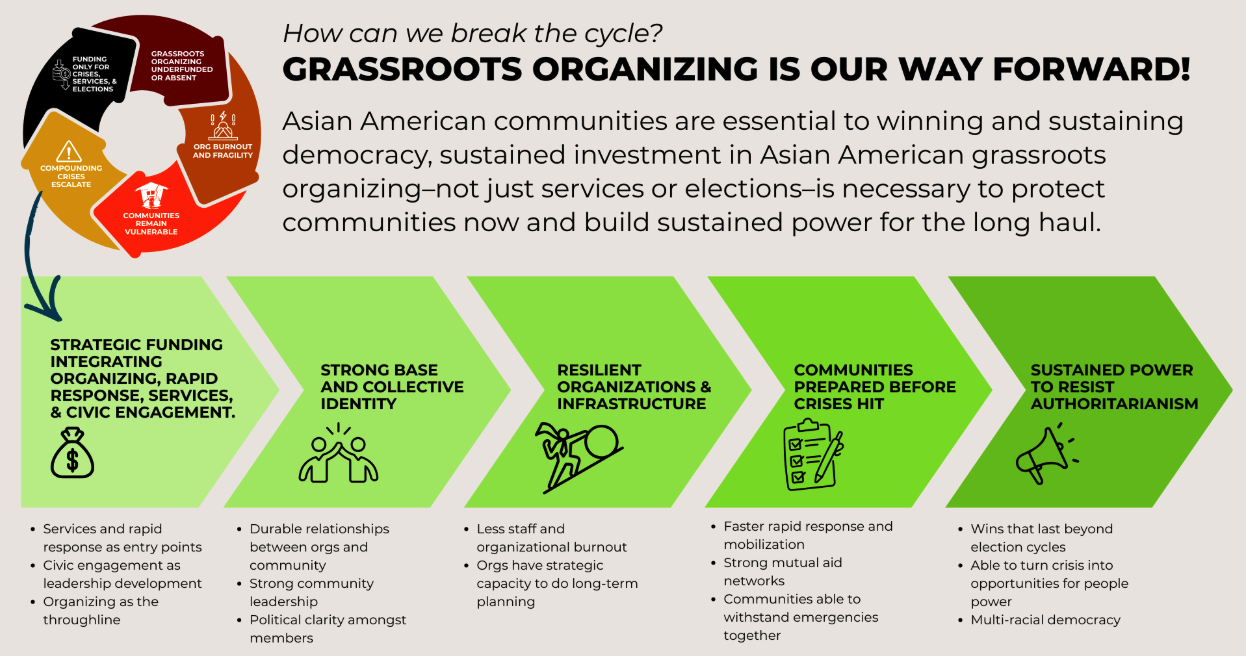
We know this cycle of disinvestment is incredibly unsustainable. Asian American communities are critically growing in the Midwest and South, and also live and work alongside other Black, Brown, and Indigenous communities throughout the country. Yet, Asian organizers lack the funding and resources needed to build long-term, sustainable organizing infrastructure, beyond just crisis response and services. Multiple member organizations in GAR have experienced funding crises, forcing them to stop key programming, lay off staff members, and restructure the organization.
When organizations have the infrastructure to turn their voter and services outreach into sustained membership bases with strong working-class leaders, we build stronger organizations that help communities face crises and win power together. With sustained investment in grassroots organizing of working-class, pan-Asian communities, we can move our communities from isolation to community protection to lasting power. Local organizations will be better equipped to integrate services, organizing, and civic engagement, meaning that we can build the infrastructure needed for durable wins now and beyond. Without sustained investment in organizing now, we remain in this cycle of unsustainably protecting communities crisis after crisis for the foreseeable future.
How has GAR been preparing our members for the Midterm elections?
The GAR Lotus & Rice Membership Convening happened in April 2026, as we were facing cuts to the TSA, violent ICE raids, escalating US attacks on Iran, and a continuing affordability crisis across the US. GAR brought together over 100 organizers from 37 organizations in Chicago. Our organizers had so much hunger and enthusiasm because people seeked resources and connections with other organizers who were facing similar conditions as them. GAR is a unique space for many organizers because it is often the only space where they get to connect with other people who are organizing working-class Asian people.
At this convening, all GAR member organizations were trained to use the Wedges Framework and committed to developing a plan to improve their membership outreach and governance structures. The tools, resources, and connections GAR members received in April helped set them up for success as they took on electoral organizing for the Midterm elections.
Wedges Framework
GAR led our members to create the Wedges Framework and Organizer Workbook to train organizations to strategically wedge pro-authoritarian forces against each other and sway people back towards community-oriented solutions. We’ve trained 300 people in Minneapolis, 400 people in Las Vegas, and 150 people in Chicago.
Leadership Ladders Cohort
GAR is launching a Leadership Ladders Cohort of over 20 organizations with 38 organizers to develop their leadership development structures and systems. Leadership ladders are a key tool for organizers to develop leaders from within our communities and help move people from isolated struggles to shared action. Stronger and larger membership bases will help us sustain grassroots organizing in the long-term fight against political attacks and polycrisis landscape.
Kitchen Table
Created in July 2025, GAR’s Kitchen Table allows members to think through organizing challenges and receive individualized coaching. GAR provides long-term support, encourages rigor in organizing, and saves our ecosystem money and costly mistakes. Since its start, 26 organizations have attended Kitchen Table across 64 sessions. When evaluated, 100% of organizers agreed that their session helped them gain clarity on a challenge.
What’s next for GAR?
Currently, GAR has 38 member organizations in 14 states, including 10 states in the Midwest and South, through individualized coaching, national membership convenings, virtual peer exchange programming, and external trainings. This work is done by four staff members.
To respond holistically to what our members need to become stronger working-class-led organizations, GAR must grow our infrastructure, programming, and staffing. Over the next several years, we hope to grow towards a larger organizations that can:
Welcome more grassroots organizations into our membership that are deeply aligned and committed to doing base building of working-class Asian communities.
Expand the Kitchen Table and other programming to offer individualized coaching session to grassroots organizers.
Encourage the growing relationship between organizers across the country by hosting more regular regional gatherings and national convenings.
Build the capacity for organizing working-class Asian communities in the South and Midwest, where resources and funding have historically been the scarcest.
Elevate that the organizing of pan-Asian communities is key to power-building and BIPOC organizing on a national level
We need your support to grow GAR’s infrastructure, staffing, and programming. Will you donate to GAR today and help grassroots organizers receive the resources, tools, and connections they need to mobilize and win?